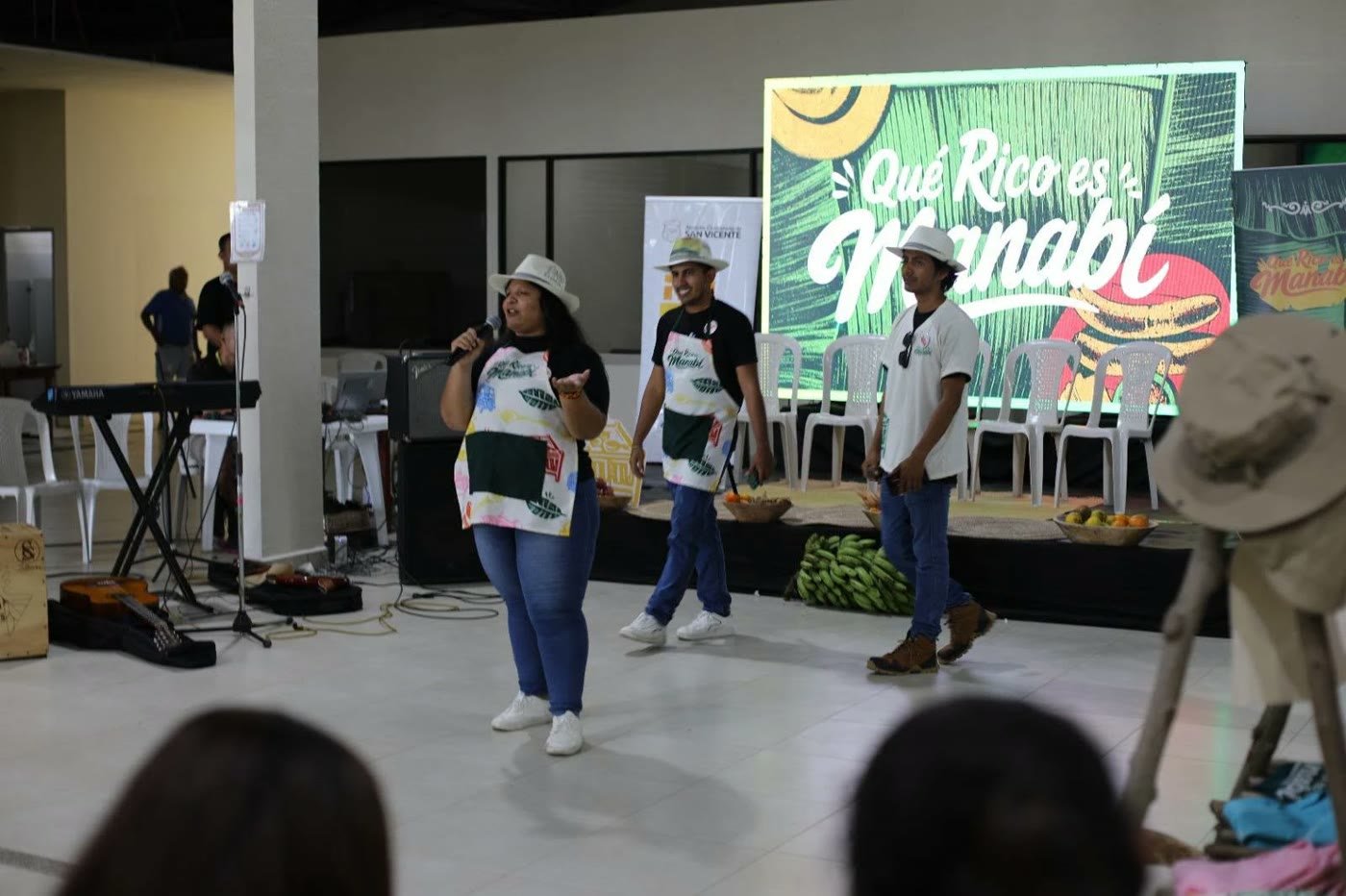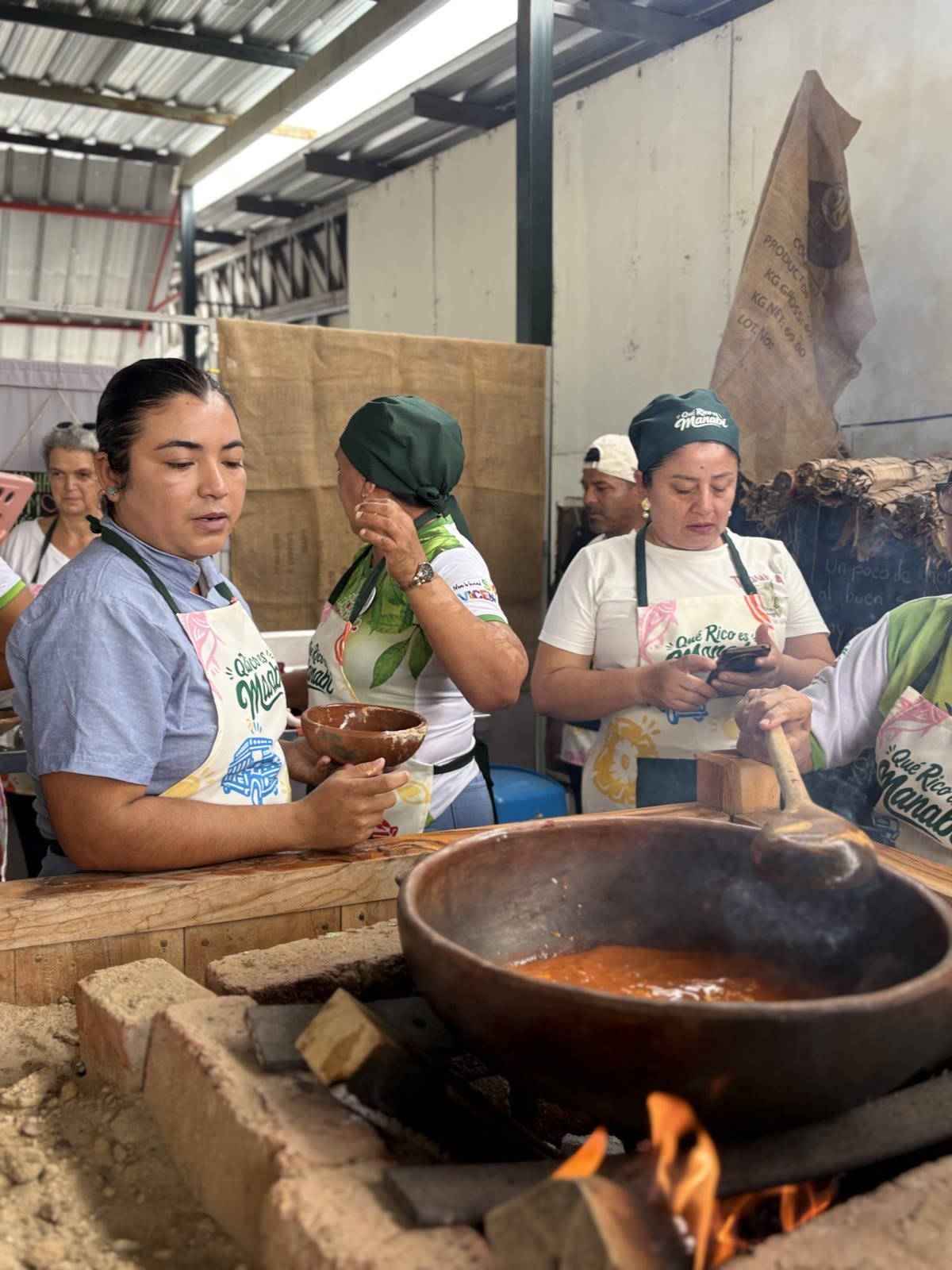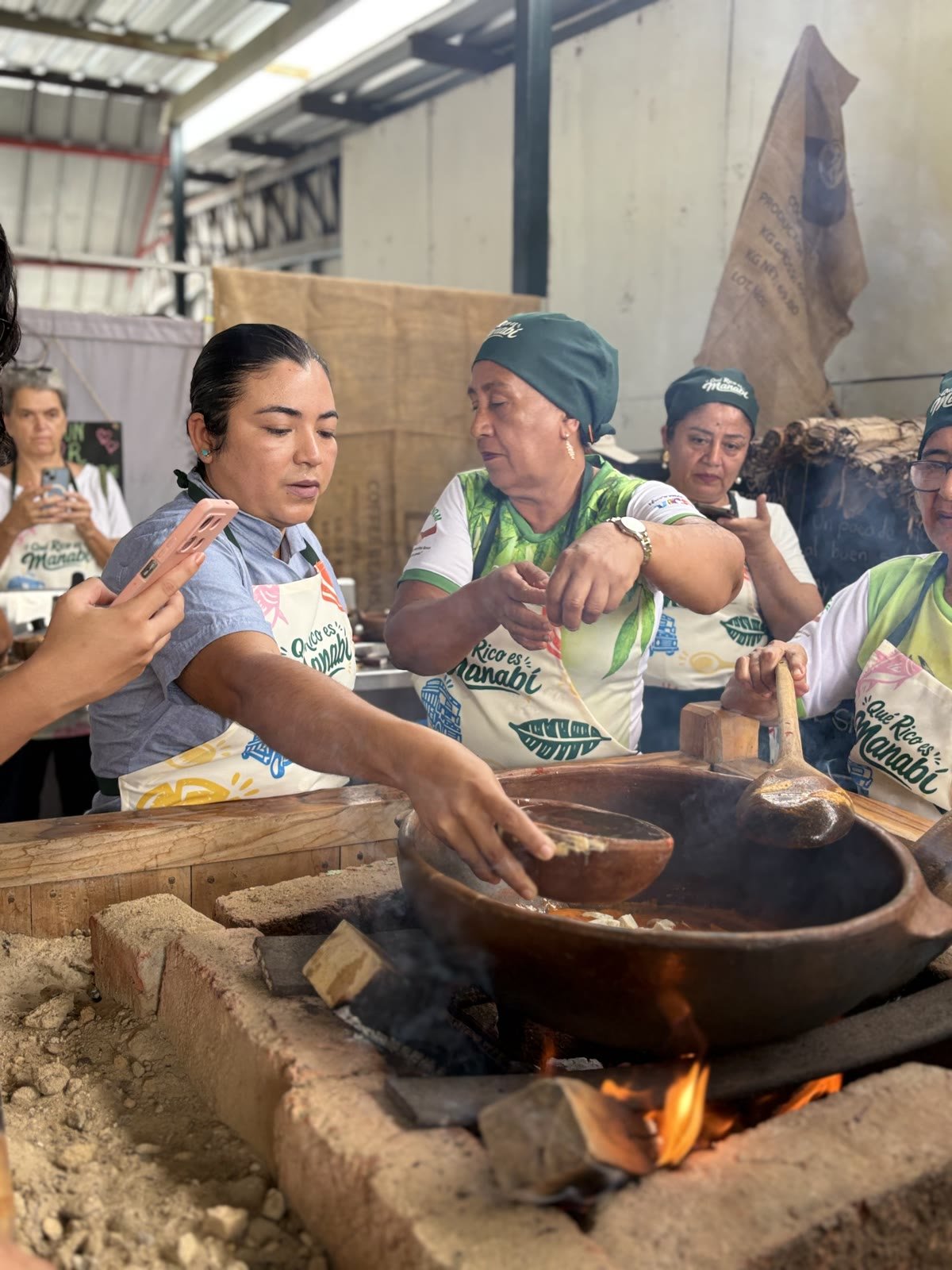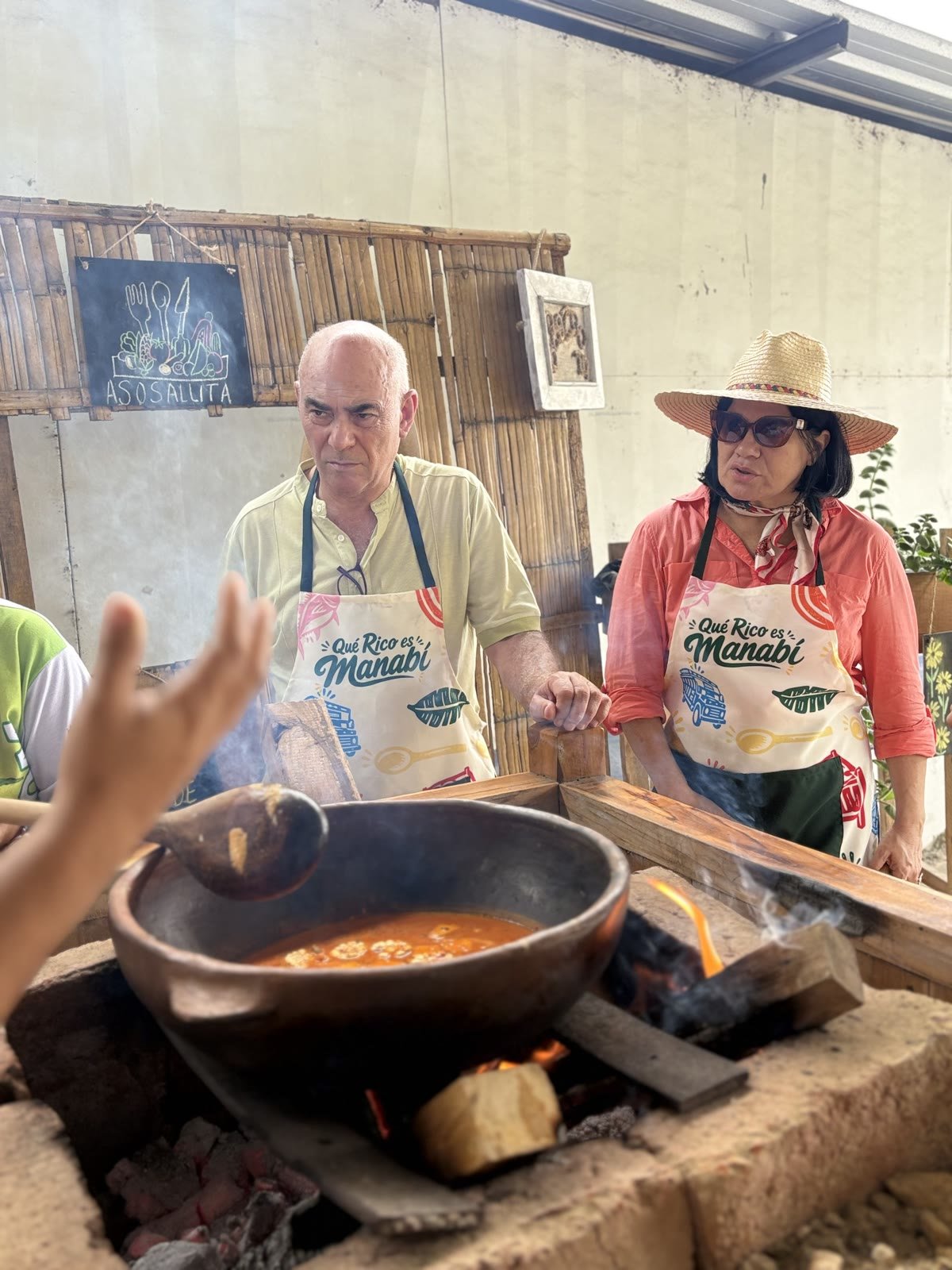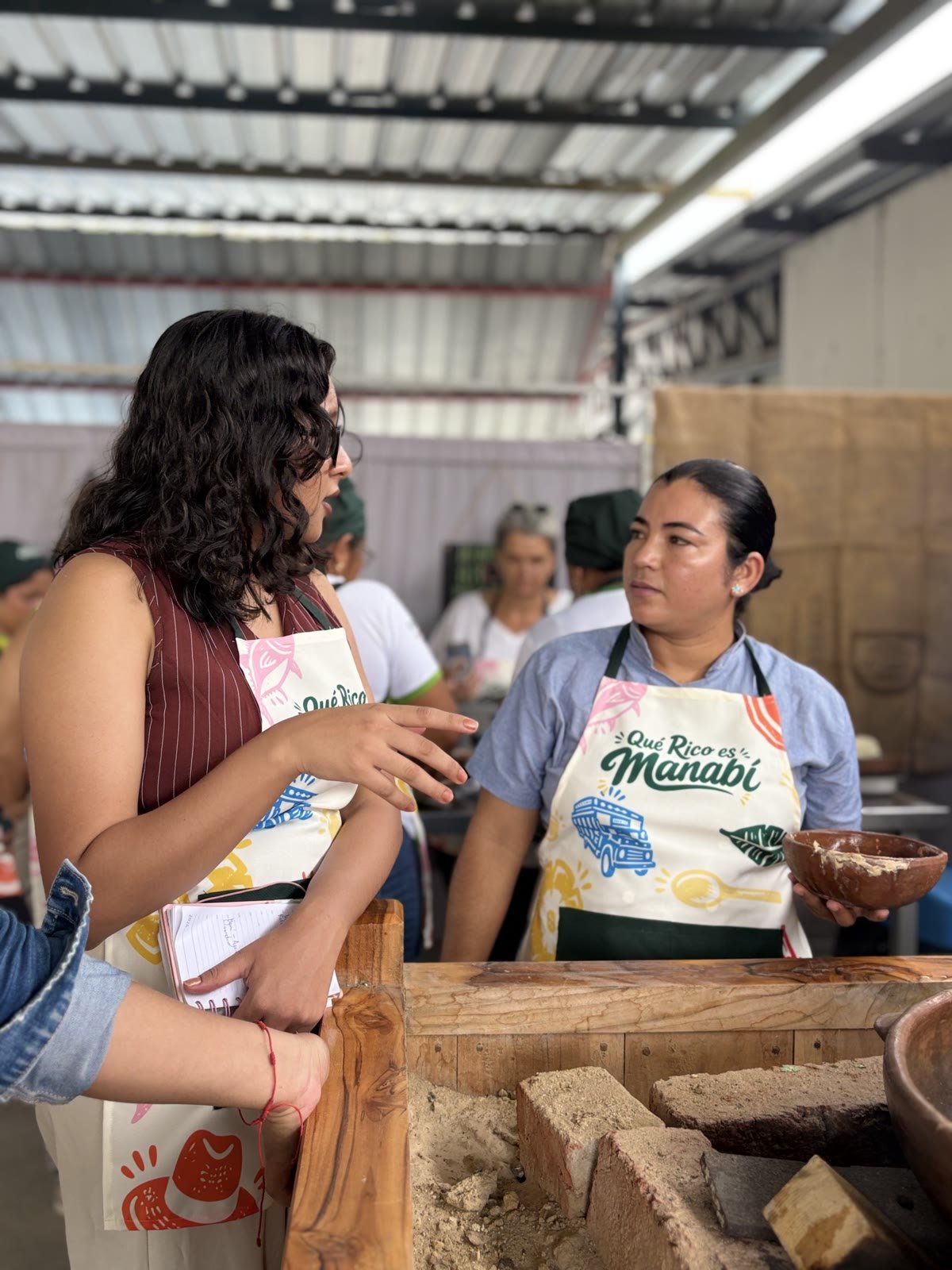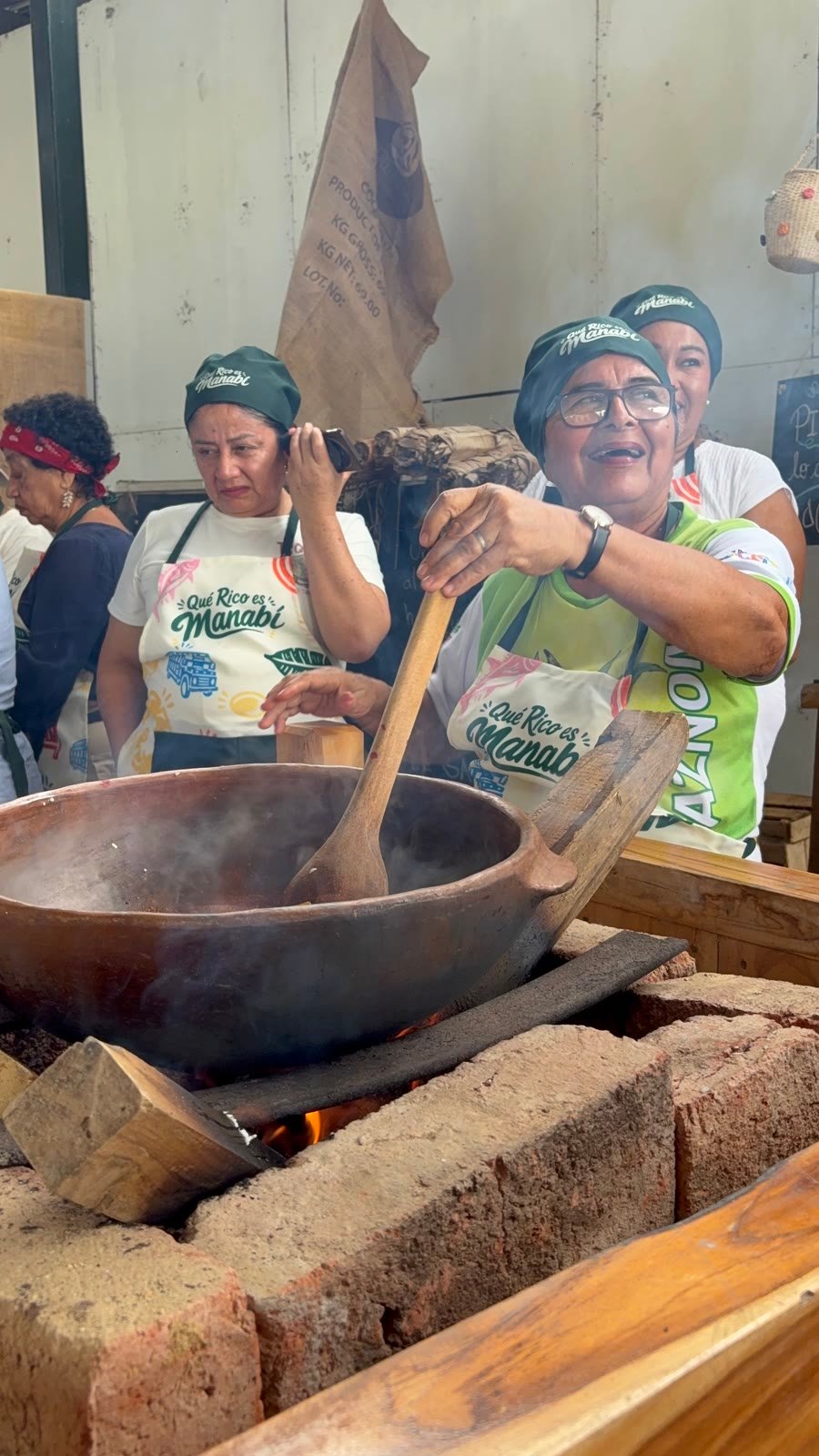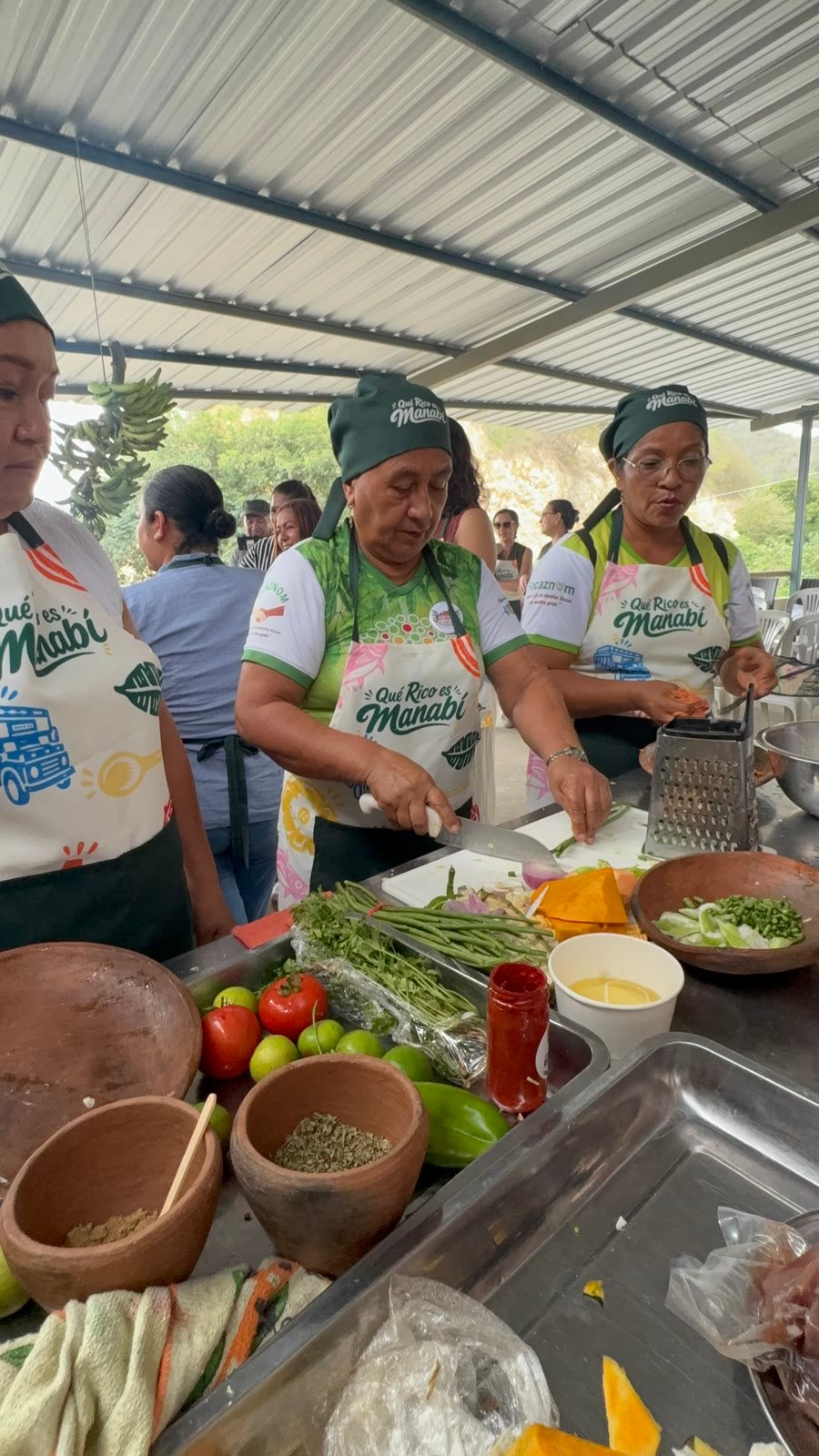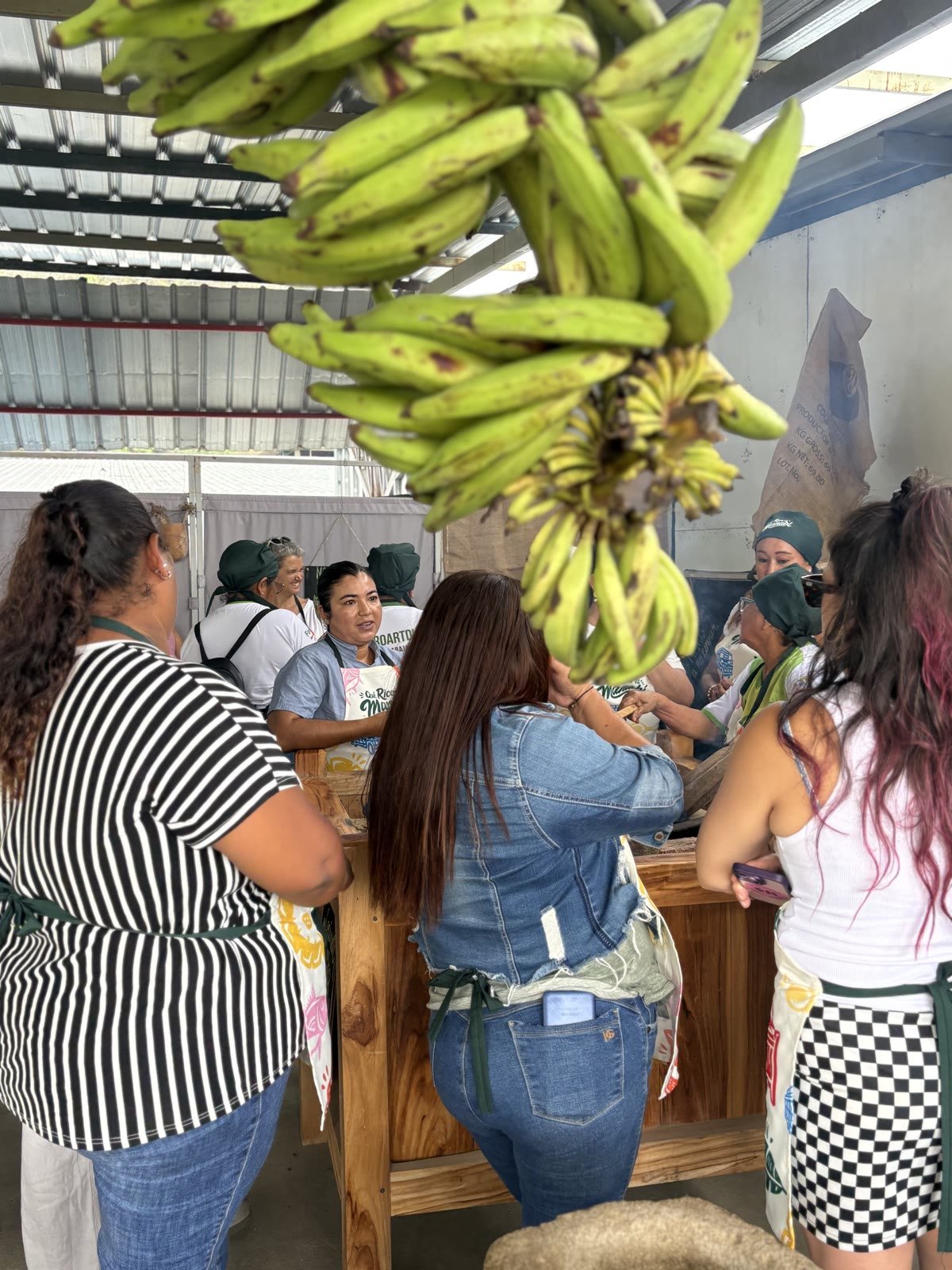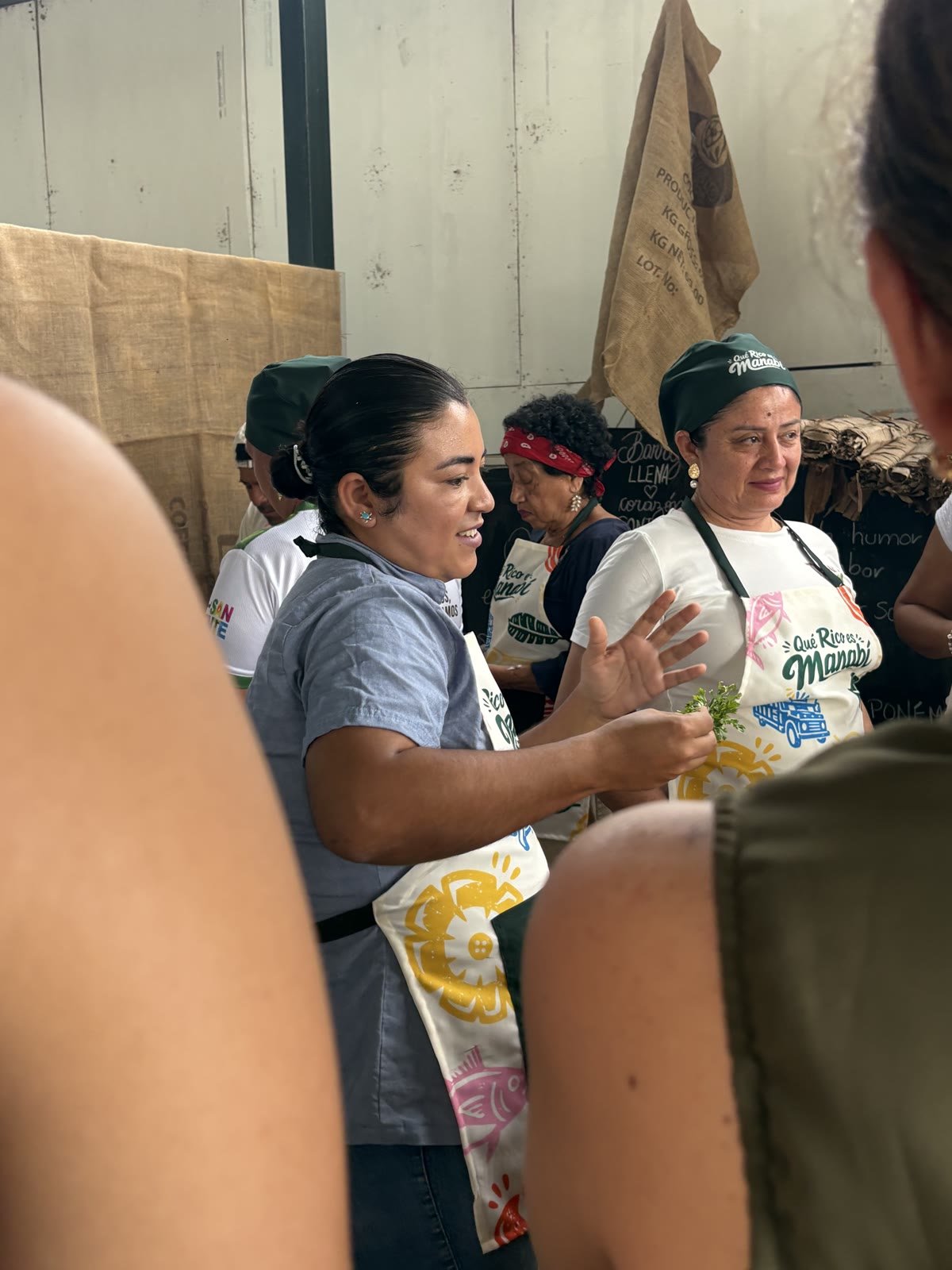
Two activities at the San Vicente market. In the morning, a food-use workshop with the market’s cooks:Saberes y Fogones. Afterward, the presentation of the campaign“Qué rico es Manabí”.
See the venues on the map →Saberes y Fogones
Account · An encounter with culinary memory: food-use workshop at the San Vicente market.
On Sunday, October 11, at the San Vicente market, across the bridge that joins it to Bahía de Caráquez, lunch started early. It started the way it always does in a market kitchen: with someone peeling, someone cutting, someone putting water on to boil. That day, though, there were other hands. Researchers and cooks from the meeting joined the preparation for service. They did not come to give a class. They came to cook alongside.
The workshop was called Saberes y Fogones — An encounter with culinary memory. Its theme was making the most of food, a technical phrase for something market cooks have always practiced: that nothing gets lost. Its method was simple and, for that very reason, rare. To work in the real kitchen, with the real menu, while preparing the food that the market’s customers would eat that same day.
The day was organized around two questions that went in opposite directions.
What advice can we share about making the most of food while we cook today’s lunch?
What do they have to tell us, from their experience, about how to make the most of food in our own work or research kitchens?
The second is the one that changes the usual order. One question goes from the laboratory to the hearth. The other returns.
What Luciana Bianchi brought from the Galápagos
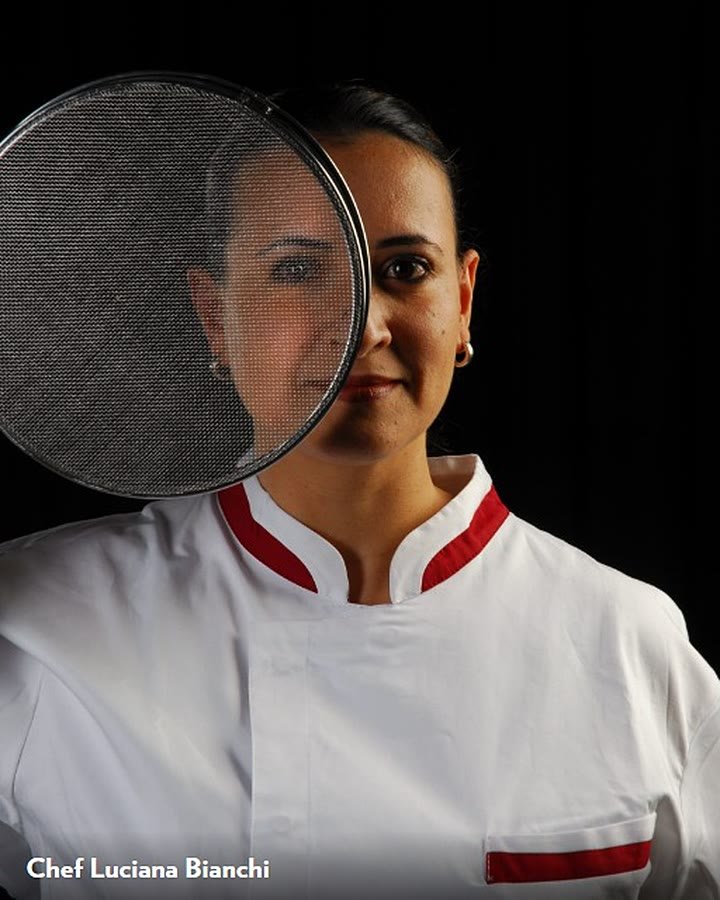
Luciana Bianchi
Her presentationScience as a tool for survival
Luciana Bianchi came from an island where almost everything comes from outside and nothing is left over. Between 2017 and 2025 she ran MUYU, a restaurant and bar in the Galápagos. She presents it as a pioneer in creating the first Galápagos cuisine, a project that led to a thesis with the Basque Culinary Center. Also as something more than a restaurant: a hub of sustainable ideas and socio-educational projects.
Her presentation has a title that does not sound like cooking:Science as a tool for survival. And two phrases that work as a declaration of principles.
Researching is an act of resilience.
Applying knowledge and protecting life are acts of responsibility.
What remains: knowledge that goes both ways
The workshop left an idea more than a recipe. Making the most of food is not an invention of laboratories. Market cooks practice it every day, out of trade and necessity, without calling it circular economy. What research can add is method, measurement and new outlets for what is discarded today. What the cooks can teach is what no laboratory has: decades of solutions tested in front of a pot and a budget.
Four lessons can be drawn from the day:
Cooking alongside teaches more than explaining.
Joining the preparation of the real lunch made it possible to talk about making the most of food with concrete ingredients and not in the abstract.
The exchange goes in two directions.
The workshop’s second question —what do they have to teach us— recognizes the cooks as bearers of knowledge, not as recipients of training.
Science can be a tool of the trade.
MUYU’s experience shows that an everyday ingredient such as cassava can be opened up into several raw materials, and that discards can be material for research.
Making the most of food is also caring.
The lessons with which Bianchi closes her presentation point out that waste is not just a cost: without natural resources there is no gastronomy to preserve and no future to feed.
Those lessons are few and direct. Put ethics and humanity before money, because not everything that has value has a price. Reconcile our relationship with nature, with real food and with culture. Learn from the past, question the present and feed the future without destroying the planet that feeds us. The last one fits in three words and could hang on the wall of any market kitchen:
Devolve to evolve. In San Vicente, that Sunday, the phrase made literal sense. To think about the kitchen of the future we had to go back to an everyday kitchen, at the hour when lunch is prepared, and listen to those who never stopped making the most of everything.Saberes y Fogones · San Vicente Market
Launch of “Qué rico es Manabí”
Account · Presentation of the campaign at the San Vicente market.
A question to begin with
On Sunday, October 11, at the San Vicente market, a campaign did not begin with a speech. It began with a question thrown to the audience: what makes Manabí special? It is a question that in a market needs no microphone. It is in the stalls, in the pots, in the people who sell and those who buy. The campaign is calledQué rico es Manabí, and that Sunday it was introduced to society in the place where the province cooks and eats every day.
Then there was bingo. T-shirts, stickers and tote bags with the campaign’s brand were raffled. Luciana Bianchi won, who had come from the Galápagos for the meeting and who that same day had taken part in the food-use workshop with the market’s cooks. A launch that begins with a question and a bingo says something about itself: that it does not want to be solemn, that it wants people to play and stay.
Then Carlos Mendoza, mayor of the Sucre canton, spoke. He thanked those who took the initiative for the project. He said that initiatives like this generate economic dynamism. He said he was moved by the young entrepreneurs taking part, because they represent Manabí’s cultural and gastronomic wealth. He said he wants to keep adding San Vicente to projects like this. And he thanked them again.
Amorfinos, dance and aprons
Then a group of kids came up to recite amorfinos dedicated to Manabí. The amorfino is the way this coast has always said what it thinks: in verse, with mischief, from memory. In their verses they thanked Iche, Fundación FUEGOS and Hivos for their contribution, and above all Iche, for its work preserving ancestral knowledge. They named the fishers, the vendors, the new generations.
Then came the folk dance group of the San Vicente canton. They also recited amorfinos. They also danced. In one same aisle the new campaign and the old tradition lived together, and neither seemed to get in the other’s way.
There was a quieter moment. The Prefecture symbolically handed out aprons to the market’s cooks. The gesture was small and the message clear: to honor the work of those who feed San Vicente every day.
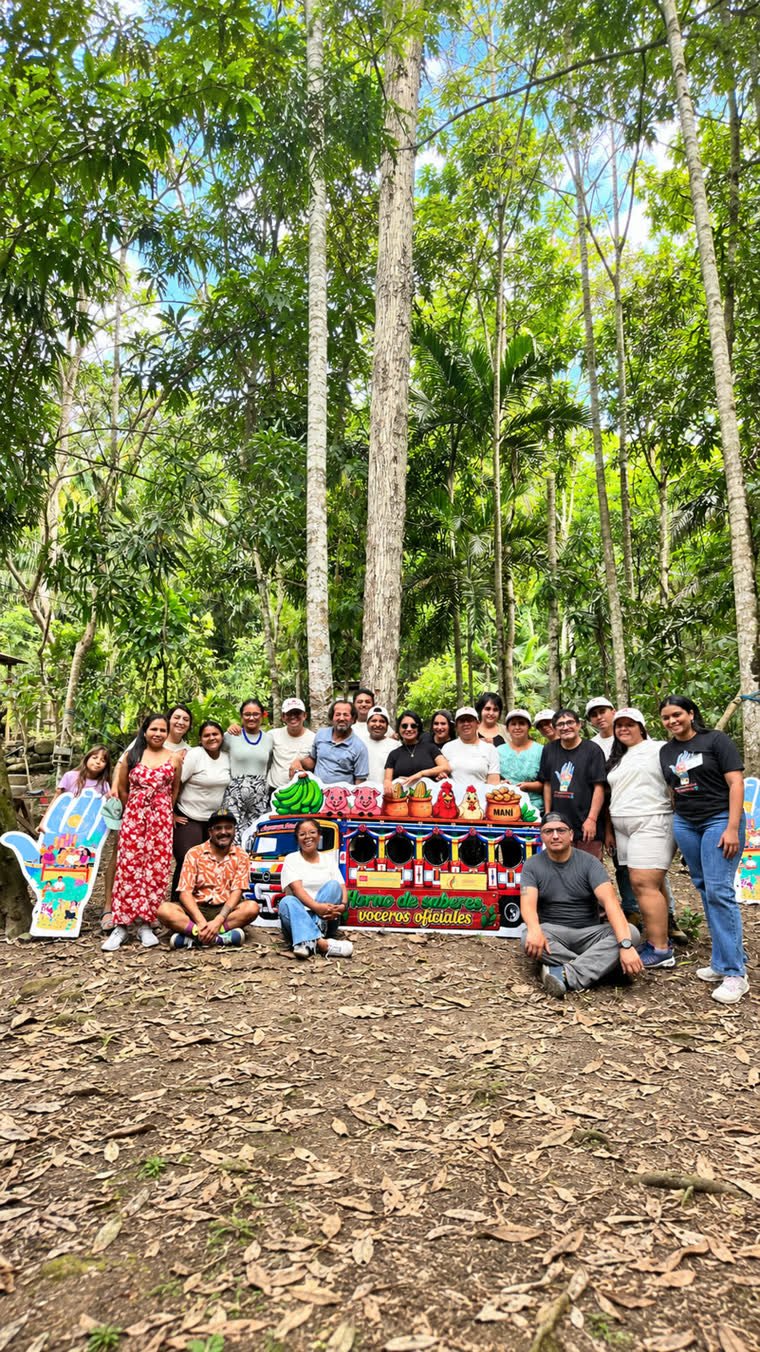
Then it was told where it all came from.Qué rico es Manabí was not born in a design office. It was born from another project,Hornos de Saberes, which set out to research together with young people, cooks, producers and knowledgeable people of the territory. From that collective listening, and from the ancestral knowledge that appeared in it, the campaign emerged. Its basis, they said, was the exchange between generations: those who know because they lived it, in conversation with those who want to know for what is coming.
Buying is also a political act
Then the young people who took part in the project spoke. They said Manabí has all the strength to be known in the world. And they said something that gently corrects much of what is said about heritage: that it is valuable to know ancestral knowledge, but more valuable to know how to build a future with that knowledge. They were not talking about keeping. They were talking about using.
The closing was by Francisco Rojas. He thanked his team, the young people and the market’s cooks. He mentioned the Americas Young Chef Award, AYCA, as a great event taking place in Manabí, a province that —he said— is reaching worldwide projection. And he left the phrase that could sum up the day:
Choosing where to buy is also a political act, an act of reclaiming Manabí culture.
He asked for one thing only from the businesses present: that they take ownership of the Qué rico es Manabí brand. That they use it. That it be theirs.
The party ended with a town band.
Systematization
A brand born from research.
Qué rico es Manabí comes from Hornos de Saberes, a process of collective listening with young people, cooks, producers and knowledgeable people of the territory. The campaign is the result of that research, not its starting point.
Intergenerational exchange as a method.
The basis of the project was dialogue between generations. The young people turned it into a slogan: ancestral knowledge is worth more when it helps build the future.
The market as a stage.
Launching the campaign at the San Vicente market, and not in an auditorium, put its protagonists at the center: cooks, vendors, fishers.
Public recognition of the cooks.
The Prefecture’s symbolic handing out of aprons and the thanks in every speech made the cooks the honorees.
Institutional backing.
The mayor of the Sucre canton linked the initiative to local economic dynamism and expressed interest in continuing to take part in similar projects.
A brand to take ownership of.
The final call was for local businesses to adopt the brand. Consumption was presented as a way of defending Manabí’s culture.
The workshop in motion
The day in pictures